

WITH - Our Relationship-Centred Approach to Dementia Care
By Sarah Reed
Support WITH-ISM
We are living through a period of irreversible public sector decline while, at the same time, there are escalating numbers of people living with dementia in the community who inevitably, need increasing amounts of support.
However, families caring for a person at home are increasingly isolated by the person’s condition and also social norms, which can sometimes be both unsympathetic and thoughtless.
At Betty’s Club our relationship-centred approach seeks to help and support members through our WITH values:
Wellbeing, Involvement, Thoughtfulness and Hope
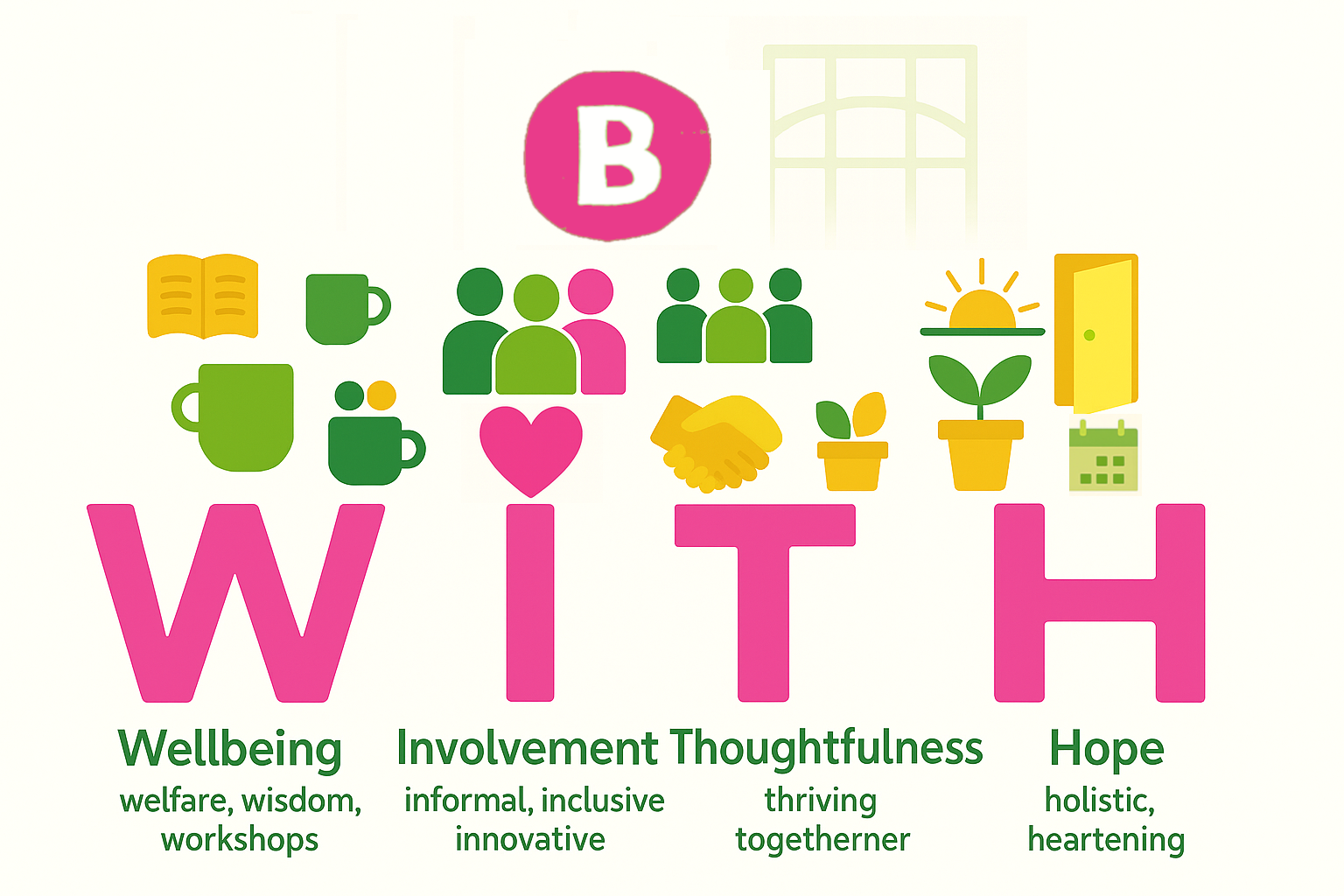
TO - WITH
Re-ablement has been a buzz word for some years, indeed I’ve run a number of workshops for struggling social services organisations on this very subject; but it is hard to achieve successfully with a person living with dementia, whose brainpower and working memory are inevitably deteriorating.
Many of us working in this sector believe that we need to move away from a long-established approach that largely does things ‘to’ and ‘at’ individuals, families and communities. ‘To-ist’ tendencies require control of any engagement. We want to move towards one that does things with them – we might call this ‘with-ism’ rather than ‘to-ism’.
TO BE WITHIST
Happily, at Betty’s Club we do everything we can to be ‘with-ists’. This means emphasising listening over telling. Listening allows our members, who have much lived – and living experience, to set both the tone and agenda for any conversation.
To be ‘With-ist’ is to get alongside the person, to listen and empathise.
It discourages us from judging and this allows us to understand the person more holistically and develop more meaningful engagement with them.
LISTENING
As with all our ‘with-ist’ innovations, at Betty’s Club, listening begins with an effort to build a deeper understanding of each member, both the person with dementia and their caregiver. That starts with gaining understanding of them, through detailed conversations with each, to map their life histories.
In getting to know the person better, we also learn more about what they want, so that they can then set the agenda for what they want to do and when and how they want to do it.
‘With-ism’ allows us to respond more sensitively to the changing landscape of dementia.
As the person’s condition changes, it helps us to adapt how we respond, so that our engagement is more continuous, thoughtful and meaningful, both to them and their carers.
Some of our members’ marvellous stories:
“… every year in the autumn, tramps used to come down from Leicester. They looked rough but were quite harmless. One day, I saw one coming along and I thought, he’s come from a long way, he must be starving.
My mother came home to find him sitting at our kitchen table eating a blackcurrant jam sandwich I’d made for him. “Oh, hello, what have we got here then?” she asked. He didn’t say much, being too busy gobbling up the food! He came back every year after that.”
“… we came to England when I was only 6 months old, so I was brought up here. My family owned a nursery garden in Hertfordshire. Not being from an English family, I experienced a lot of bullying from local children at school, but there were gypsy children in my class and they stood up to them on my behalf and then it stopped…
… I didn’t come face to face with my father until I was six years old, when I was taken to meet him at the bus station in Northampton as he arrived back from the war. I remember noticing that he was very pleased to see my mother!”